Ubuntu’s September 2004 Preview and Its Debian Roots
A new Debian-based distribution appears
In September 2004, Ubuntu attracted attention as a new Linux distribution with a focused desktop installation. A September 27 Slashdot discussion points to a Debian Planet story from September 16, alongside the project’s announcement and a related interview. The first preview is distinct from the final release that followed in October.
Ubuntu’s October 20, 2004 release announcement explains the project’s early goals: a selected collection of applications, a predictable release schedule, accessible installation, and defined support commitments. These goals made the distribution’s approach different from simply offering another way to download Debian packages.
What a derivative changes
Sharing a package format does not guarantee that every package can be exchanged between two distributions. Different library versions, build choices and dependency relationships can affect whether a package installs correctly. A derivative may also choose different default applications, settings and release processes.
The distinction is particularly important for administrators. Understanding Debian’s package-management tools can help someone learn Ubuntu, but a repository intended for one distribution should not automatically be enabled on the other. Supported installation and upgrade paths depend on the release and its own package sources.
Looking back without rewriting the timeline
The preview period helps explain why early discussions focused on usability and project direction. The final release announcement establishes what the project actually released, and later history should not be projected onto that initial moment. Ubuntu became an example of how a common technical foundation can support different product and community priorities. The useful historical question is not which distribution won a contest, but how each approached the relationship between package breadth, release timing and the desktop experience.
The desktop as a deliberate selection
A distribution with a large package archive offers considerable freedom, but the breadth of that archive does not automatically create a simple first-use experience. A new user might not know which editor, browser, file manager or office application to select. The person building an installation for a school or family computer faces a similar question: which initial choices will create a useful environment without requiring every user to become an administrator?
Ubuntu’s early approach was to make a selection of software part of the identity of the distribution. The official Warty announcement presented the default installation as a manageable set of applications backed by a much larger repository. This was a product design choice as much as a packaging choice. The software available after installation did not represent the entire range of things that the distribution could do. It represented a proposed starting point from which users could explore further.
The distinction matters when comparing other Debian-based distributions. A derivative can choose a particular desktop, hardware target or installation medium while still benefiting from the work of Debian package maintainers. A smaller default installation is not necessarily a smaller software ecosystem, just as a large archive is not necessarily difficult to use. The important questions are how packages are presented, how the initial system is configured, and how a user can maintain it after making additional choices.
Installation media in the context of 2004
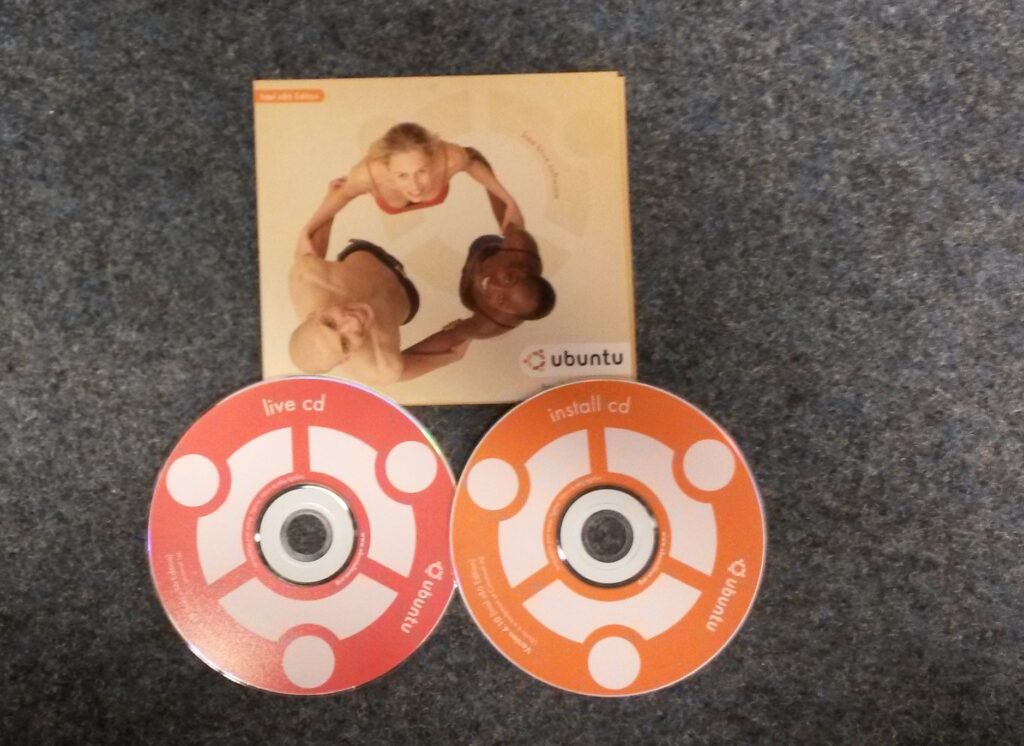
The availability of physical installation media was particularly meaningful during a period when not every prospective Linux user had fast or reliable Internet access. The Ubuntu release announcement offered physical CDs alongside downloads. The installation disc represented a practical means of obtaining an operating system and a selection of applications without first downloading a large archive.
A live disc and an installation disc can serve different purposes. A live environment allows a person to try a system before committing to a disk installation, while an installer prepares a persistent environment. A successful live session may reveal that a display, keyboard or network adapter works, but it does not prove that every installation scenario will succeed. Conversely, an installer may produce a working system without giving the user an opportunity to explore the full desktop beforehand.
The first Ubuntu release included a distinction between its installation media and a live image described as a release candidate. This helps establish the precise nature of the initial announcement. It would be misleading to assume that all the familiar installation workflows of later Ubuntu releases were already present in exactly the same form in September 2004. Contemporary installation reviews are valuable because they record what the early software actually offered to users at that time.
Release cadence and the work behind it
A predictable release schedule helps users decide when to adopt a new version, and it helps organizations plan testing and deployment. It is not the same thing as a guarantee that any particular desired application will appear in the next release. Developers must still decide when to stop accepting new features, how to address regressions and which changes are appropriate during a period of support.
Ubuntu announced a six-month release cadence and an eighteen-month support commitment for its initial release. Those commitments describe the Warty-era project, not the support terms for every subsequent edition of Ubuntu. A modern reader should consult the documentation for a currently supported release rather than apply the original announcement to later versions. The historical point is that the new distribution made release timing and support part of its stated value to users.
Debian and Ubuntu also need to be understood as separate projects with their own decisions about package versions and release readiness. Work from one may be valuable to the other, but that relationship does not require their archives to be identical at a given moment. A package can be available in one project before it is integrated in the other, and a distribution may modify a package to meet its own requirements. For users, the relationship is best understood as shared technical foundations with distinct operating environments.
Another important measure of a derivative is its upgrade path. A system intended for repeated releases has to account for users who have already installed an earlier version, customized their settings and accumulated documents. A new installation demonstrates only one part of that experience. A well documented release process gives administrators a way to plan the next step and determine whether their applications require special testing.
Community infrastructure is part of a distribution
A new operating system requires more than an installation disc. People need somewhere to report problems, ask questions and find documentation. Developers need ways to coordinate changes and explain decisions. The Warty announcement identified mailing lists, a wiki and discussion channels as part of this community infrastructure. They offered routes for users to become participants rather than simply recipients of software.
This is a useful lens for reading the early reviews linked from Slashdot. Installation ease was important, but the longer-term experience would also depend on the availability of updates, the clarity of documentation and the ability to obtain help. A favorable first impression was evidence of a successful introduction, not proof that all future maintenance questions had been resolved.
The September preview occupies an interesting place in that history because it captures a distribution before the benefits and difficulties of its later development were known. Reading it together with the October release announcement allows the early project to be understood on its own terms. Its significance is the demonstration that a distribution can reuse a substantial technical foundation while making deliberate choices about the desktop, support and the relationship between developers and users.